 Large Image
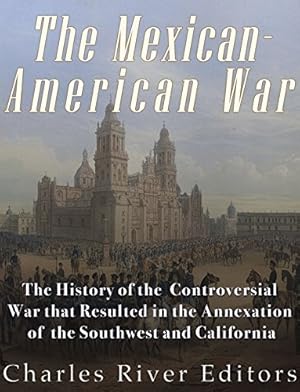
The Mexican-American War: The History of the Controversial War that Resulted in the Annexation of the Southwest and California

Share This
Description
*Includes pictures
*Includes accounts of the war written by generals
*Includes footnotes, online resources and a bibliography for further reading
*Includes a table of contents
"Generally, the officers of the army were indifferent whether the annexation was consummated or not; but not so all of them. For myself, I was bitterly opposed to the measure, and to this day regard the war, which resulted, as one of the most unjust ever waged by a stronger against a weaker nation. It was an instance of a republic following the bad example of European monarchies, in not considering justice in their desire to acquire additional territory." - Ulysses S. Grant
The policy of manifest destiny increased tensions with Mexico in the 1840s. Mexico's northern half formed the western border of the territory bought in the Louisiana Purchase. Naturally, notions of the United States expanding to the Pacific Ocean alarmed Mexico, which held what is today the west coast of the United States. However, Mexico first came to regard American expansion as a serious problem with the immigration of Americans into its northeastern territory. These Americans declared independence from Mexico and created a nation in the Mexican province of Texas. After winning independence in 1836, Texas became an independent republic.
Texas formally asked to be annexed by the United States in 1845. This annexation angered the Mexican government, which still considered Texas to be part of its territory. Mexico had previously warned that the annexation of Texas would cause Mexico to declare war on the United States. When the annexation bill was passed by Congress, it included an additional provocation to Mexico: it claimed that the southern border of Texas was the Rio Grande. The actual territory controlled by the Republic of Texas did not extend nearly to the Rio Grande, and this border would represent a further loss of territory to the United States.
When a Mexican patrol attacked American cavalry in the disputed area north of the Rio Grande, President Polk went to Congress for a declaration of war. The declaration passed on May 13, 1846. The war against Mexico was unpopular with the opposition Whig party, especially in the North. Opponents of the war denounced it as a war of aggression, and denied that there had been a valid reason for war.
Small American military units were quickly able to occupy key points in California, including San Francisco and Los Angeles. Although California was sparsely populated, some Mexican inhabitants formed an effective resistance which was eventually put down in 1847 by American reinforcements. Subsequently, a larger American army was sent to invade central Mexico, and managed to capture the Mexican capital, Mexico City, on September 13, 1847. Although a large Mexican army was still fighting American forces in northeast Mexico and Texas, news of the capital falling caused it to retreat to try to retake the capital. After the defeat of the last Mexican army, major hostilities ended.
The Treaty of Guadalupe Hidalgo ended the Mexican-American War in February 1848. Mexico agreed to sell over half its territory for less than half of the money the United States had offered only two years earlier. As the Army occupied most of Mexico's major cities, Mexico had no choice but to accept the American terms. The new territory acquired in the treaty included all or part of the present day states of California, Nevada, New Mexico, Arizona, Texas, Colorado, Utah, and Wyoming.
The Mexican-American War: The History of the Controversial War that Resulted in the Annexation of the Southwest and California looks at the controversial war. Along with pictures of important people, places, and events, you will learn about the Mexican-American War like never before, in no time at all.
Tag This Book
This Book Has Been Tagged
Our Recommendation
Notify Me When The Price...
Log In to track this book on eReaderIQ.
Track These Authors
Log In to track Charles River Editors on eReaderIQ.